Most new managers think they lose deals to competitors.
Stop demanding “more dials” from a team that is already exhausted.
Start architecting a system that removes the one thing actually stopping your buyers: Fear.
Manage the “Fear of Messing Up” (FOMU) before it kills your Q1.
From Firefighter to Revenue Architect
It’s 4:45 PM on a Thursday. You’re staring at your CRM “Commit” forecast. There’s a $150k deal sitting in the “Evaluation” stage. It was supposed to close yesterday. Your VP just Slacked you: “Status on the Acme Corp deal? We need it for the board report.”
Your heart rate spikes. You do what every Firefighter does: You call the AE into your office (or a Zoom).
“What’s the hold-up?” you ask. The AE shrugs, looking defeated. “They love us. The champion said that the demo was ‘mind-blowing.’ But now they’re ghosting me. I’ve sent three ‘checking in’ emails this week. Should I offer a 15% discount to get them over the line?”
This is the moment you choose your path.
The Firefighter says, “Yes, give them the discount, but tell them it expires tomorrow. And call the champion’s cell phone until they pick up.” This is an attempt to put out the fire with gasoline. It treats the buyer like a target to be captured, rather than a human who is likely paralyzed by the fear of making a high-stakes mistake.
The Revenue Architect pauses. They realize that if the demo was mind-blowing and the buyer is now silent, the problem isn’t the price.
The problem is Indecision. The buyer isn’t worried about the “Cost of Inaction” (they know they have a problem); they are terrified of the Cost of Action—the possibility that if this software fails, they will be the one explaining the “mess” to the Board.
The Cost of Chaos | The Six-Figure Risk
The “No-Decision” Tax
In the Series B-E world, “No-Decision” is your biggest competitor. It’s a silent tax that erodes your leadership credibility and your team’s morale.
1️⃣ Forecast Erosion
When you can’t distinguish between a “delayed” deal and an “indecisive” deal, your forecast is just a wish list.
2️⃣ Margin Bleed
Every time you offer a discount to solve a “silence” problem, you are training your buyers that indecision is profitable.
3️⃣ The “Expertise” Gap
AEs who only know how to push never learn how to lead. Without a system to manage indecision, they stay stuck as order takers.
To move from Firefighter to Architect, you must master the JOLT Methodology. Based on the research in The JOLT Effect, we know that up to 60% of lost deals are not lost to competitors—they are lost to “No Decision.”
The Architect’s job is to build a Risk-Reduction Engine.
The Competency Path
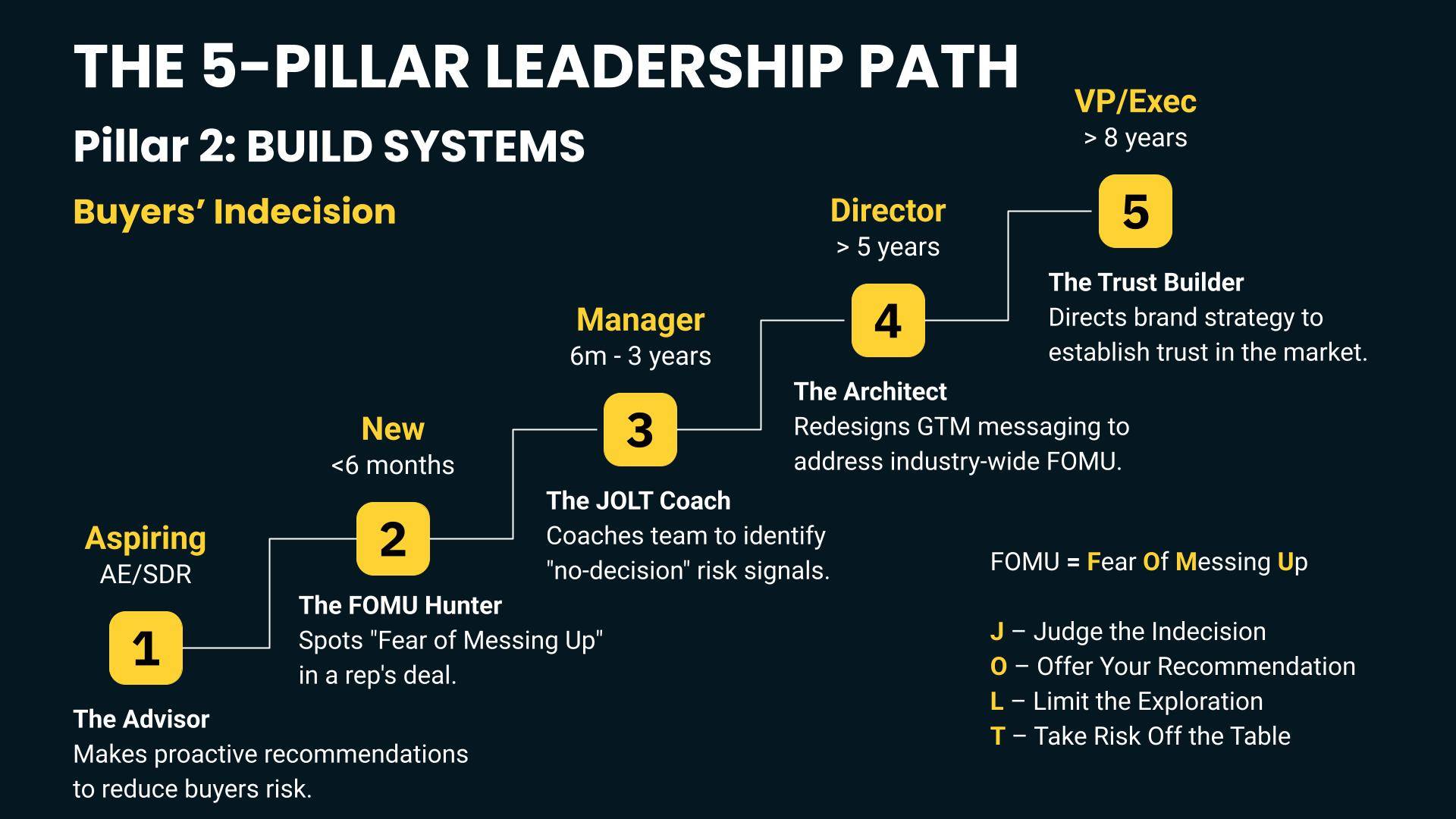
Managing the psychology of a buyer is the higher sales leadership competency. Use this scale to audit your own leadership style and your team’s maturity:
The 5-Pillar Leadership Path – Build Systems: Buyers’ Indecision
Your Success Sprint
Triage the Zombie Pipeline
The first step in Architecting a predictable engine is Triaging your data. You cannot treat every stall with the same medicine.
1️⃣ Identify the “Pre-Freeze” Signal (Pillar 2: Build Systems)
Before a buyer ghosts, they leave digital footprints. They stop opening the “Pricing” or “ROI” decks and start obsessively sharing the “Security,” “GDPR,” or “Implementation” docs.
The Architect’s Move: When you see this, don’t send a “Checking in” email. Send a Recommendation: e.g.“I noticed you’re looking at our security protocols. Most leaders at your stage worry about data integrity during the migration. I’ve attached our ‘Zero-Downtime Blueprint’ to address those specific concerns.”
2️⃣ Apply the “48-Hour JOLT” (Pillar 3: Build People)
If an engaged Economic Buyer goes silent for 48 hours after a proposal, Indecision has set in.
The Architect’s Move: Coach your AE to use the “O” in JOLT (Offer a Recommendation). Instead of asking “What do you think?”, they should say: “Based on our work so far, I recommend we start with a Pilot in Department X. This limits your risk while proving the ROI before the full rollout. Does that help lower the internal pressure?”
3️⃣ The CSM Bridge (Pillar 5: Build Relations)
One of the most powerful ways to Take Risk off the Table (The “T” in JOLT) is to introduce the Customer Success Manager (CSM) before the contract is signed.
The Architect’s Move: Bring the CSM into the final Closing call. Not to sell, but to show the “30-Day Safety Net.” When a buyer sees the person who will actually be doing the work, the fear of being abandoned vanishes.
Action Beats Perfection: Your Next Step
Don’t let your forecast lie to you for another week. Take these three steps to architect a “Fear-Proof” process:
1️⃣ Build your “Downside Protection” Slide
Look at your standard pitch deck. It’s likely 10 slides of “How Great We Are.”
The Action: Add Slide 11: What if this fails?
The Content: Specifically list the 3 most common risks and exactly how your system mitigates them. Showing you aren’t afraid of the messy parts of implementation builds more trust than a perfect demo ever could.
2️⃣ Audit your “Closed-Lost: No Decision” recordings
Spend 60 minutes this Friday listening to the final calls of deals that died.
The Goal: Look for the unasked questions. Where did the buyer hesitate? Did the AE talk over a concern about the team bandwidth? That hesitation was the seed of the FOMO that eventually killed the deal.
3️⃣ Implement the “Weekly Triage” Scorecard
In your next 1:1, have your AEs score their “Commit” deals on a scale of 1-5 for Buyer Confidence.
1: High Indecision (The Red Zone) Buyer is stuck in Analysis Paralysis.
2: Passive Interest (The Danger Zone) Buyer agrees with the value but is Micro-Ghosting.
3: The Technical Plateau (The Pivot Point) Buyer has validated the ROI but has shifted the conversation to Security, IT, and Legal.
4: Internal Alignment (The Green Zone) Buyer has introduced you to the Implementation Lead.
5: Committed Partnership (The Closing Zone) Buyer has publicly committed to a Go-Live date.
The Rule: Any deal at a “2” or lower cannot be in the forecast without a JOLT Intervention Plan.
👉 The Architect’s Closing Thought
A Sales Manager’s job is not to make people buy. It is to build an environment where it is safe to buy. When you solve the buyer’s fear, the revenue takes care of itself.
Stop firefighting the silence. Start architecting the safety net.
See you in the Next Success Sprint,
Sonia Pupaza | Founder, Empower Value | Sales Leadership Expert
I help high-performing ICs and new managers become successful leaders.